

NATS-LA STUDENT AUDITIONS: COLLEGIATE DIVISION
BOTH MUSICAL THEATER & CLASSICAL DIVISIONS
Saturday, March 7, 2026
(approx. 9AM-5PM)
Azusa Pacific University
901 E. Alosta Avenue, Azusa, CA 91702

You must first login to nats.org, then click on AuditionWare
Joel Balzun, NATS-LA Collegiate Chair collegiate@natslachapter.org
Dr. Michele Patzakis, APU Site Host mpatzakis@apu.edu
OVERVIEW
For the past two decades, the annual NATS-LA Collegiate Auditions has provided an outstanding opportunity for post-secondary students to perform before qualified NATS adjudicators and to meet and hear singers from other colleges and universities. It also offers NATS teachers a venue for their students to perform, as well as a space for camaraderie and networking. Prizes may be awarded to top-scoring students in various categories.
ELIGIBILITY FOR PARTICIPATION
● Student Eligibility: Only matriculated college students currently receiving individual instruction in classical voice and/or musical theatre from a NATS-LA teacher on a college or university faculty may participate. Teachers must register their students through AuditionWare on the NATS website. Teachers are not permitted to register students they are not currently teaching under any circumstances.
● Teacher Eligibility: Teachers registering students must be members of the Los Angeles Chapter of NATS in good-standing. All teachers sending students must serve as adjudicators, or help the Collegiate Auditions Coordinator secure a qualified replacement. Students whose teachers do not fulfill this requirement will be ineligible to participate.
If your NATS-LA Membership has lapsed or you would like to join, please contact our Membership Chair, Ida Nicolosi at membership@natslachapter.org.
REGISTRATION INFORMATION
Starting this year, NATS-LA Collegiate Auditions registration—including payment of all fees—will be processed through AuditionWare, accessible via the NATS website. Complete instructions may be found on the site.
Fee structure:
● Teacher fee (attending the auditions): $35
● Teacher fee (not attending the auditions): $70
● Student registration fee per category: $40
Registration fees include access to a NATS-LA staff collaborative pianist for all rounds of the audition. All registered students must perform with the NATS-LA staff collaborative pianist.
All NATS-sponsored audition events and their chairpersons are required to follow NATS Auditions Regulations to the greatest possible extent, including policies regarding age limits, category assignments, and repertoire requirements. The NATS-LA President has the authority to enforce all regulations governing the auditions, ensure that scores are tabulated accurately, and resolve any issues arising from infringements of length-of-study or repertoire requirements. Standardized NATS adjudication rules and forms will be used. All participants will receive additional information about the adjudication process prior to the auditions.
Checks will be made payable to the name submitted on the student’s registration. Students should therefore not register using stage names and register using either their legal name or the name under which they can receive payment.
2026 NATS-LA COLLEGIATE: IMPORTANT DATES
● Sunday, January 11, 2026 at 7PM: Zoom info session for NATS-LA members and their students, and any other voice teachers and students interested in participating in Collegiate Auditions
● Monday, January 12, 2026: Registration Opens on AuditionWare
● Wednesday, February 18, 2026 at 11:59PM: Registration Closes on AuditionWare (all fees must be paid and submitted by this time)
● No later than Sunday, February 22, 2026: Audition and Adjudication Schedules sent to teachers and students
● Sunday, March 1, 2026 at 2PM and 8PM: Zoom Orientation Meeting for all registered teachers and students
● Saturday, March 7, 2026: Collegiate Auditions at APU
DIVISION STRUCTURE
All students must be enrolled in voice lessons at a community college, college, or university program at the time of the auditions. A student’s division is determined by their length of study—and then by age—on the day of the auditions (March 7, 2026). It is ultimately the teacher’s responsibility to determine the appropriate division for each student. Please make these decisions carefully and contact the Chair if you have questions or if you believe a student does not fit clearly into one of the categories.
Students may elect to sing for comments only (these entrants will not be eligible for prizes). Students may also participate in both classical and musical theatre divisions.
Beginning this year, the categories formerly known as “Super Sophomore” and “Super Senior” will be renamed “Mature Student Lower College” and “Mature Student Upper College,” respectively. There is also a new similar category for graduate students called “Mature Student Graduate.” These categories have no age limit and include special considerations for community college students. Their purpose is to recognize, include, and celebrate students whose educational journeys have followed non-traditional paths.
CLASSICAL DIVISIONS AND TERMINOLOGY
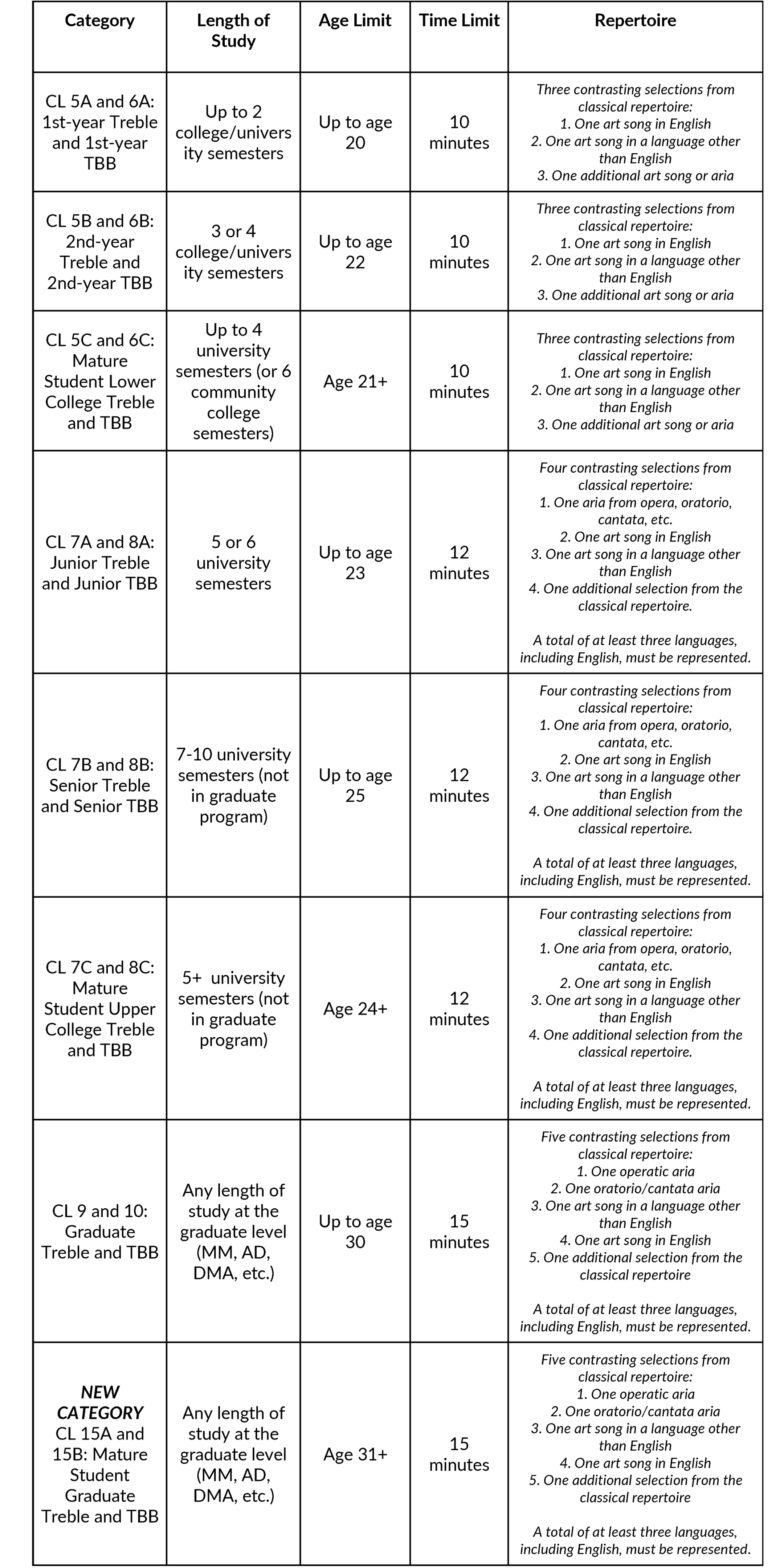
Aria: An aria is a solo taken from an opera, oratorio, mass, cantata, zarzuela, operetta, or works titled “concert aria.” Oxford Online definitions will be used for the purposes of this audition. For example, Purcell’s selections from the semi-operas and masques are considered songs.
24/26/28 Italian Art Songs and Arias: The repertoire found in the 24/26/28 Italian Art Songs and Arias collections may be counted as an aria or an art song in the high school and lower college classical categories. For the singers in the upper college categories and beyond, these pieces may count as an art song ONLY, regardless of origin. Any repertoire found outside of these collections will be considered only as the composer intended, as an art song OR aria.
Repertoire/Categories: The word “classical” in this context refers to art songs and arias from the “classical” genre, not limited to the “Classical” period of Mozart and Haydn. In other words, no music theater, pop, soul, jazz, rhythm and blues, etc. Published arrangements of folk songs, spirituals, and traditional hymn tunes in English are widely accepted as a part of the classical genre. Students in classical categories may present one selection of this type to fulfill the English art song requirement.
Memorization: All repertoire must be performed from memory with the exception of Oratorio, Mass, Requiem, and Cantata Arias. Singers may hold music scores for these types of arias as is traditional performance practice.
Original Languages: Selections should be sung in original language or in translation if warranted by common performance practice.
Transposition: Published transpositions are permitted. Singers are expected to retain the composer's intended style of music and to convey the essence of the character portrayed in the larger work. Performances not fulfilling these requirements may result in lower scores from adjudicators. Octave displacement is a transposition.
Art Song in English: English must be the original language set by the composer to meet the Art Song in English requirement. Arias from opera, oratorio, mass, etc. do not count toward this requirement.
Classical Repertoire: In CL categories, the word “classical” refers to art songs and arias from the classical genre, not limited to the Classical period of Mozart and Haydn. No musical theatre, pop, gospel, soul, jazz, rhythm and blues, etc. may be entered in the Classical Category. Published classical arrangements of folk songs, spirituals, and traditional hymn tunes in English are widely accepted as a part of the classical genre; students in classical categories may present one selection of this type to fulfill the Art Song in English requirement.
Judicious Cuts: Full, complete selections are required; however, judicious cuts in piano introductions, piano interludes, piano music after the vocal solo is completed as well as internal cuts within arias are allowed as is common professional performance practice. Cuts of verse or verses of selections are not allowed. In the case of strophic pieces, all verses should remain that are traditionally included.
Double-Dipping: Singers entering both CL and MT categories are allowed to enter only ONE duplicate selection in both categories provided the repertoire requirements of each category are met. Teachers and students are reminded that the standards of performance in NSA’s genre categories are different. A successful audition in one category will not necessarily produce success in a second category—unless the interpretation is altered to address the different standards of performance. Standards of Performance are defined in each NSA adjudication rubric. If a singer advances to the final auditions in more than one category, they may not sing the same selection in multiple final auditions. Please see the NSA FAQ for additional information.
Comments Only: Any student may register to sing for comments only and participate in the preliminary audition round.
MUSICAL THEATRE DIVISIONS AND TERMINOLOGY
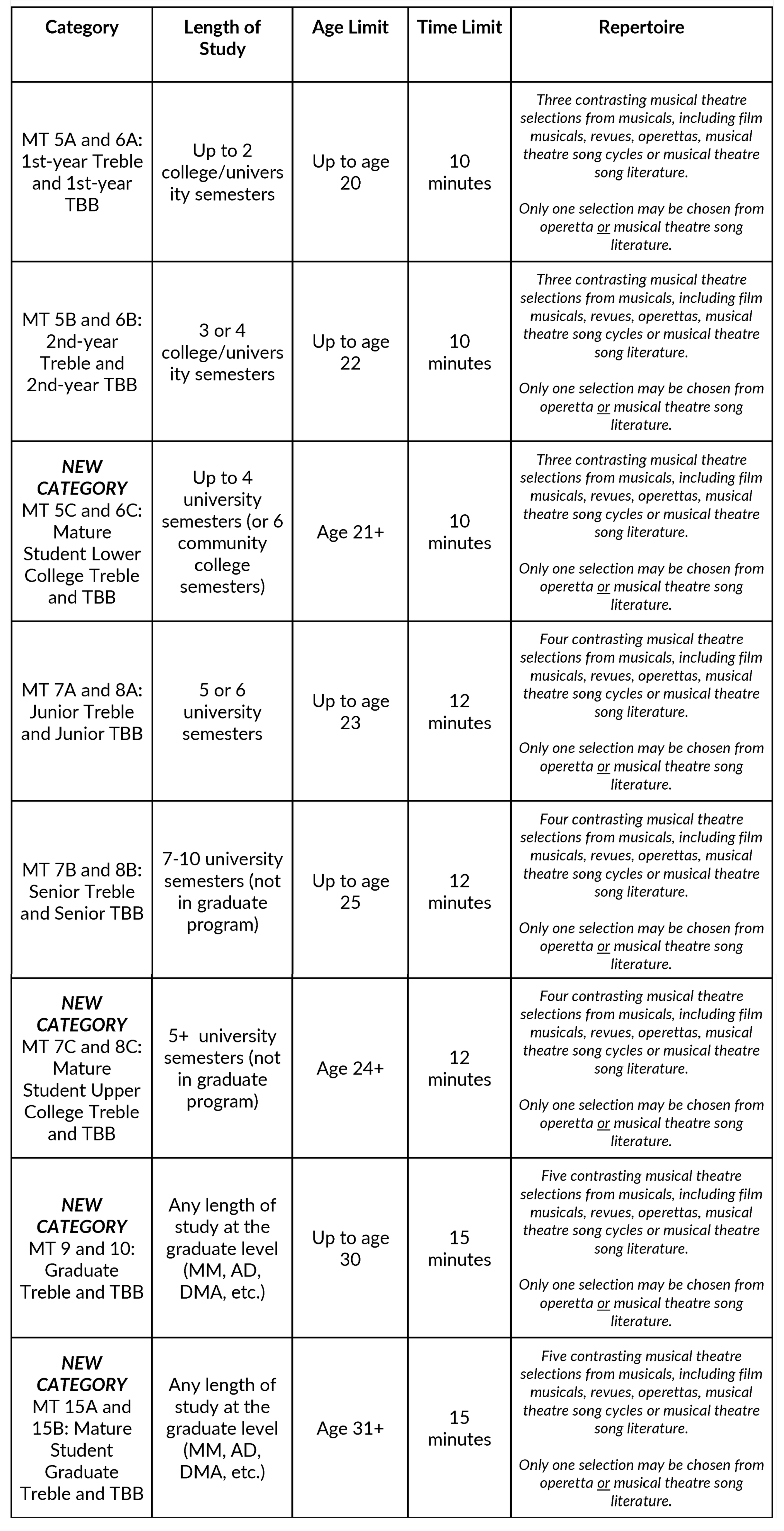
Musical Theatre Selections: Repertoire is selected from musicals including filmed, animated, televised, or internet musicals, revues, operettas, theatrical song cycles, televised or streamed musical series, and musical theatre song literature. Only one of the required selections may be an operetta aria or from musical theatre song literature.
Musical Theatre Song Literature: MT Song Literature is defined as songs by a composer of musicals. MT Song Literature includes songs cut from musicals, songs from unfinished musicals, songs from unproduced musicals, songs written specifically for musical theatre celebrities, or cabaret-styled musical theatre songs not from a musical.
Musical Theatre Styles: The singer is expected to select musical theatre songs from varied styles of music including bluegrass, blues, calypso, country, electro-pop, folk, gospel, jazz, legit, operetta, pop, pop-opera, rap, rhythm and blues (R&B), rock, soul, etc. The selected repertoire will engage the singer’s ability to access a variety of vocal colors to communicate character and story (see musical theatre rubric). The audition will showcase the full spectrum of each singer’s vocal and dramatic abilities.
Acting: In an MT audition, a student is portraying a character telling a story. A story requires a distinct beginning, middle, and ending. When integral to the character and storytelling, physical movement is essential. Movement that does not serve to facilitate the character’s communication should be avoided. Fully danced choreography should be avoided.
Selecting Musical Theatre Songs: Know a song’s context in the musical’s story including which character in the musical sings the song and which part of the musical’s story the song tells. Is the student believable telling the song’s story? An honest and believable performance is a rubric standard of performance adjudicated in MT categories.
Contrasting Selections: Contrasting musical theatre selections will vary in tempo, dramatic content, composer, era of musical’s premier, character portrayed, vocal colors, and style of music. Two or more songs by the same composer are a violation of this regulation. A lack of variety among selections may result in a lower preliminary audition score.
Transpositions: Published transpositions are permitted, but singers are expected to retain the composer's intended style of music and to convey the essence of the character portrayed in the larger work. Octave displacement is a transposition.
Judicious Cuts: Full, complete musical theatre solos are required; however, as commonly found in professional performance practice: judicious cuts in piano introductions, piano interludes, piano music after the vocal solo is completed, and dance breaks in musical theatre selections are allowed. Brief lines from a second character may be cut. In the case of more than three verses, some verses may be cut.
Original Languages: Selections must be sung in the original language or in translation as warranted by common professional performance practice.
Memorization: All selections must be performed from memory.
Double-Dipping: Singers entering both CL and MT categories are allowed to enter only ONE duplicate selection in both categories provided the repertoire requirements of each category are met. Teachers and students are reminded that the standards of performance in NSA’s genre categories are different. A successful audition in one category will not necessarily produce success in a second category—unless the interpretation is altered to address the different standards of performance. Standards of Performance are defined in each NSA adjudication rubric. If a singer advances to the final auditions in more than one category, they may not sing the same selection in multiple final auditions. Please see the NSA FAQ for additional information.
CM Arrangements in MT: Commercial Music arrangements (jazz, swing, gospel, etc.) of songs originally conceived for any type of musical, may only be entered in NSA’s Commercial Music Categories.
AUDITION PROCEDURES
THE PRELIMINARY AUDITION FORMAT
All participating singers will be identified by a registrant number. At no point during the auditions should the singers announce their name, teacher or institution. Students singing for comments only may introduce themselves by name.
Collaborative pianists are valued partners in auditions. The use of tablets and iPads are allowed. Electronic scores must be copyright compliant. No NSA audition will restart due to a malfunction of an electronic device.
Each singer entered in the same category is allotted the same amount of time to perform, as outlined in the student divisions. Singers select and announce their first song or aria to perform. The adjudication panel requests subsequent selections until the audition reaches the time limit or the singer performs all repertoire entered. Time begins when the singer begins to introduce themselves and announce their first selection.
Time continues to run between selections. In NSA preliminaries, each adjudication panel’s chair should expedite a rotation cycle among the panel members for subsequent repertoire selections. Repertoire selections should be made without delay because time continues to run between selections.
During the audition, selections are to be sung in their entirety as prepared by the student and required by the NSA Regulations, WITHOUT edits from adjudicators. Examples of prohibited edits are requesting a singer start at the B section or suggesting a student skip a prepared recitative and start with the aria or stopping a student in the middle of a piece to move on to the next selection.
Repertoire is heard as the time limit allows. If exceeding the audition’s time limit, all repertoire will not be heard. An audition reaching the time limit will end when the time limit is reached even if a selection is in progress. Teachers should inform their students of this possibility. Adjudicators may not end an audition early, if any entered repertoire remains yet to be heard—even if insufficient time remains to hear a significant portion of the remaining song/aria.
When an adjudicator or timekeeper calls or signals “stop,” the audition is completed and will end promptly.
Adjudicators should not factor time usage into the student’s score; finishing early or not filling the time limit carries no merit or penalty.
RATING AND SCORING SYSTEMS
Singers in all categories will sing one song of their choice followed by songs selected by their adjudicators until the category’s time limit is reached or the student has performed all selections entered.
During the preliminary auditions, adjudicators will use the NATS rubrics to write constructive comments and a score between 70 and 100 on their adjudication form. At no point during the auditions should adjudicators confer with one another for scoring or comments.
Audition scores will be used to advance 3 singers per category to the Finals. In the event of ties, a semifinal audition procedure as outlined by NSA Regulations may be used as a run-off to determine the finalists, at the discretion of the Collegiate chairperson.
SPECIAL CONSIDERATION FOR SMALL CATEGORIES: In categories with 5 or fewer singers, up to 3 singers will move on to the finals who receive either an average score of at least 90 from all three adjudicators or a score of at least 90 from at least two adjudicators. Singers will then perform for 1st/2nd/3rd as in any other category. If no singers in such a category achieves the aforementioned scoring criteria, that category will have no finalists; no prizes will be awarded in that category. At no point during the auditions should adjudicators confer with one another.
THE FINAL AUDITION FORMAT
Each student will sing one song of his/her choice in its entirety. This selection must be one of a song or aria from the required repertoire entered. Some auditions may place a time limit on the selection performed in finals. Selections chosen should take any required time limits into consideration.
The adjudicators will not confer. Each adjudicator independently ranks the finalists from 1 (highest) through to the number of finalists auditioning. Results are returned to the Auditions Office/Tabulation Room and tabulated. Lowest total scores are awarded appropriate prizes and/or recognitions.
All awards are presented after Finals are completed. Awards are presented publicly, at which point names of students, teachers and institutions will be announced.
Following the conclusion of the Collegiate Auditions, prizes may be mailed to students from the NATS-LA Treasurer. Prizes will be mailed to the mailing addresses submitted through AuditionWare. Accumulated student and teacher entrance fees, minus expenses, will be distributed as monetary awards among the winners.
COPYRIGHT POLICY
Reproduction of a copyrighted work constitutes copyright infringement unless the reproduction is an “authorized” copy, meaning:
● a license to reproduce such work has been obtained
● the use is considered “fair use” (a bit complicated, read copyright resources)
● the work is in the public domain in the country OR
● a valid exception to copyright infringement exists
Read more details here. For information on the use of iPads and other tablets, click here.
CONTACT INFORMATION
For questions about audition procedures, repertoire and registration, please contact Joel Balzun (NATS-LA Collegiate Chair) at collegiate@natslachapter.org.
For questions about the venue, including parking and accessibility, please contact Dr. Michele Patzakis (APU Site Host) at mpatzakis@apu.edu.
Thank you for considering this valuable opportunity for you and your students!